
A two-week ceasefire has been reached between the US and Iran, though formal negotiations have yet to begin. In the meantime, Iran looks to have effectively established control over the Strait of Hormuz, reportedly imposing a $2 million toll on each vessel that passes through.
This is estimated to generate an additional $90 billion in revenue, on top of roughly $60 billion in annual oil income.
By this calculation, Iran would now rank as the richest country in the Middle East. A clear paradigm shift has taken place: Global attention has moved away from uranium enrichment and toward control of the Strait of Hormuz.
During the Israel-led war, the United States spent approximately $42 billion in just 39 days. The killing of Supreme Leader Ali Khamenei and others triggered a destructive chain of events that rapidly escalated the conflict.
In June 2025, Trump had ordered strikes on Iran even as negotiations were still ongoing — talks in which Iran was reportedly offering significant concessions.
When Trump later halted the bombing, Iran also stopped its attacks on Israel. Eight months later, near the end of February 2026, Oman — acting as mediator between Washington and Tehran — announced that Iran had agreed to halt all uranium-enrichment activities and return them to a “natural” state.
This arrangement appeared even more restrictive than the 2015 JCPOA agreement negotiated between Iran, the Obama administration, and major world powers.
Trump had previously withdrawn from the JCPOA, demanding a “better” deal, despite many experts — including some in Israel — viewing the original agreement as effective.
Nevertheless, despite Iran’s concessions, Israel and the United States disregarded the arrangement and began widespread bombing of Iran on February 28.
The motives behind such costly and counterproductive actions are not difficult to identify. Elites tied to the military-industrial complex and Wall Street often benefit from prolonged crises, while Israel has historically leveraged instability to reinforce its regional dominance.
Citing Article 24 of the UN Charter, more than 100 international law experts have described the conflict as a “war of aggression.”
Lessons of the past not learned
Washington appears to be repeating familiar mistakes — from the Cold War to the post-9/11 era — once again overestimating military power while undervaluing diplomacy.
This reliance on hard power has repeatedly produced expensive and counterproductive outcomes.
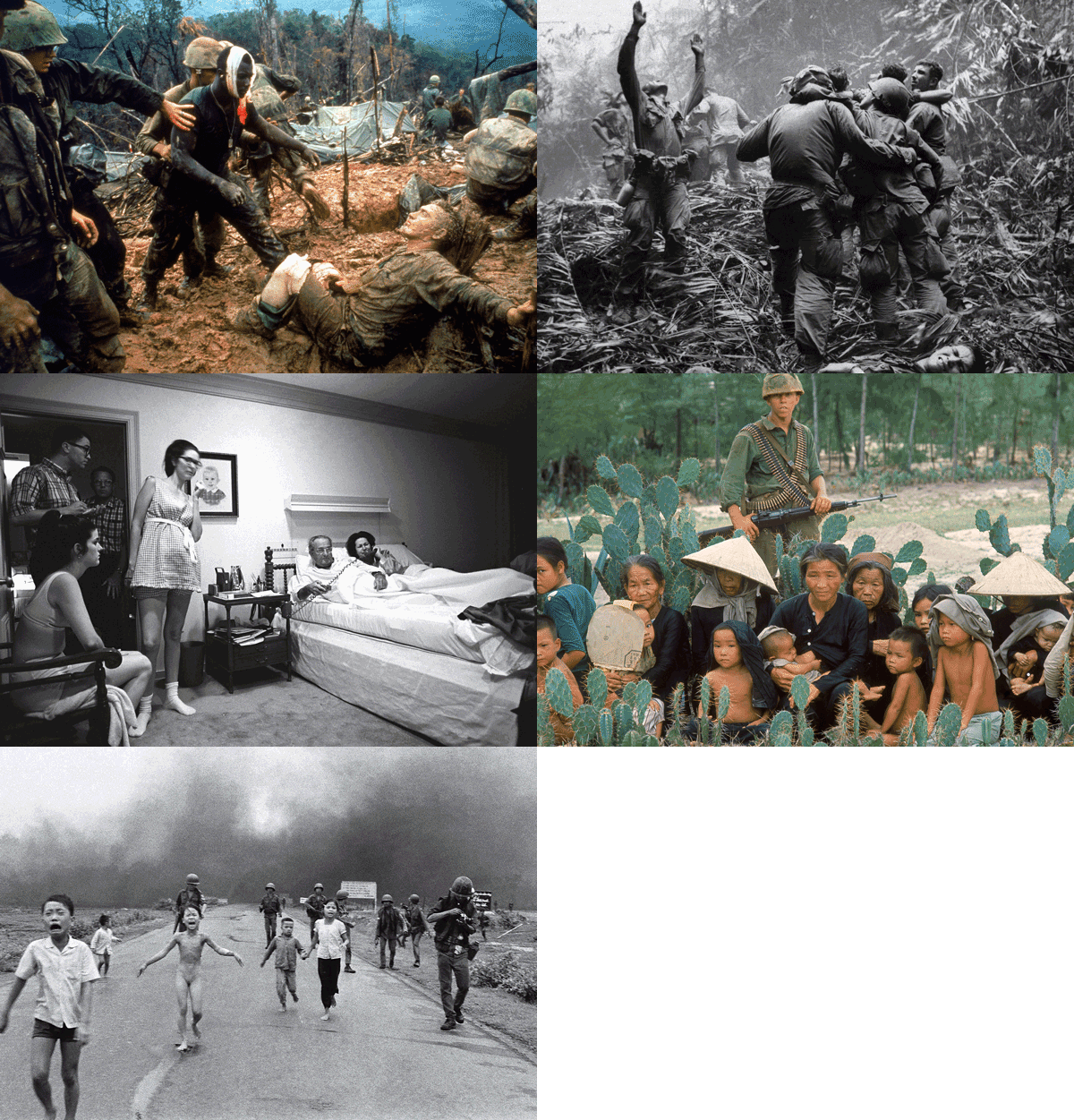
During the Vietnam War, the United States won many battles but ultimately lost the war and failed to achieve its strategic objectives. Over roughly 15 years, about 60,000 Americans and three million Southeast Asians were killed.
America’s moral authority suffered greatly. A country that had once enjoyed global trust under leaders such as Woodrow Wilson and Franklin Roosevelt increasingly came to be viewed as an imperial power.
After 9/11, the two-decade “War on Terror” followed a similar trajectory. Despite tactical victories, the United States failed to secure lasting strategic success.
Approximately $8 trillion was spent, 4,400 American soldiers were killed, and Iraq and Afghanistan were left unstable and devastated.
The US withdrew from Iraq in 2012, leaving a fragile political order, and in 2021 returned power in Afghanistan to the Taliban — two decades after invading to remove them and establish democracy.
Economist Jeffrey Sachs has argued that after 9/11, Israeli leadership and pro-Israel advocates promoted a strategic vision often described as a “clean break,” aimed at weakening or dismantling states considered hostile to Israel.
Countries frequently mentioned in this context include Libya, Sudan, Somalia, Syria, Yemen, Iraq, and Iran.
This framework helps explain Israel’s persistent efforts to draw the United States into confrontation with Iran — efforts that failed under previous US presidents but ultimately succeeded under Trump.
The war — widely seen as avoidable — generated global sympathy for Iran despite criticism of its political system and the role of the Islamic Revolutionary Guard Corps.
Instead, the conflict left the United States and Israel diplomatically isolated. Neither NATO allies nor most Middle Eastern partners joined the war.
Iran, meanwhile, emerged with strengthened regional influence, including growing leverage over Sunni-majority states.
Countries that had long depended on Washington for security have begun quietly questioning whether the United States would protect them in future crises.
Statements from some Israeli political figures suggesting that Turkey could be next after Iran further heightened these concerns.
No regional country now appears willing to confront Iran directly. Tehran has gained confidence from facing two powerful adversaries simultaneously and avoiding defeat.
A broader geopolitical shift is underway in the Middle East, mirroring changes in the global order.
A multipolar world — with new norms and shifting balances of power — seems to be emerging.
In this sense, Washington’s actions have opened a Pandora’s box in the Strait of Hormuz.
From the beginning of the conflict, renowned political scientist Professor John Mearsheimer of the University of Chicago described the war as “a colossal mistake.”
Or perhaps, as some argue, it may ultimately prove to be a blessing in disguise.
Ruby Amatulla is a political and geopolitical observer and analyst. Views expressed are the writer’s own.
Published by: https://www.dhakatribune.com/opinion/op-ed/407375/did-iran-checkmate-the-us